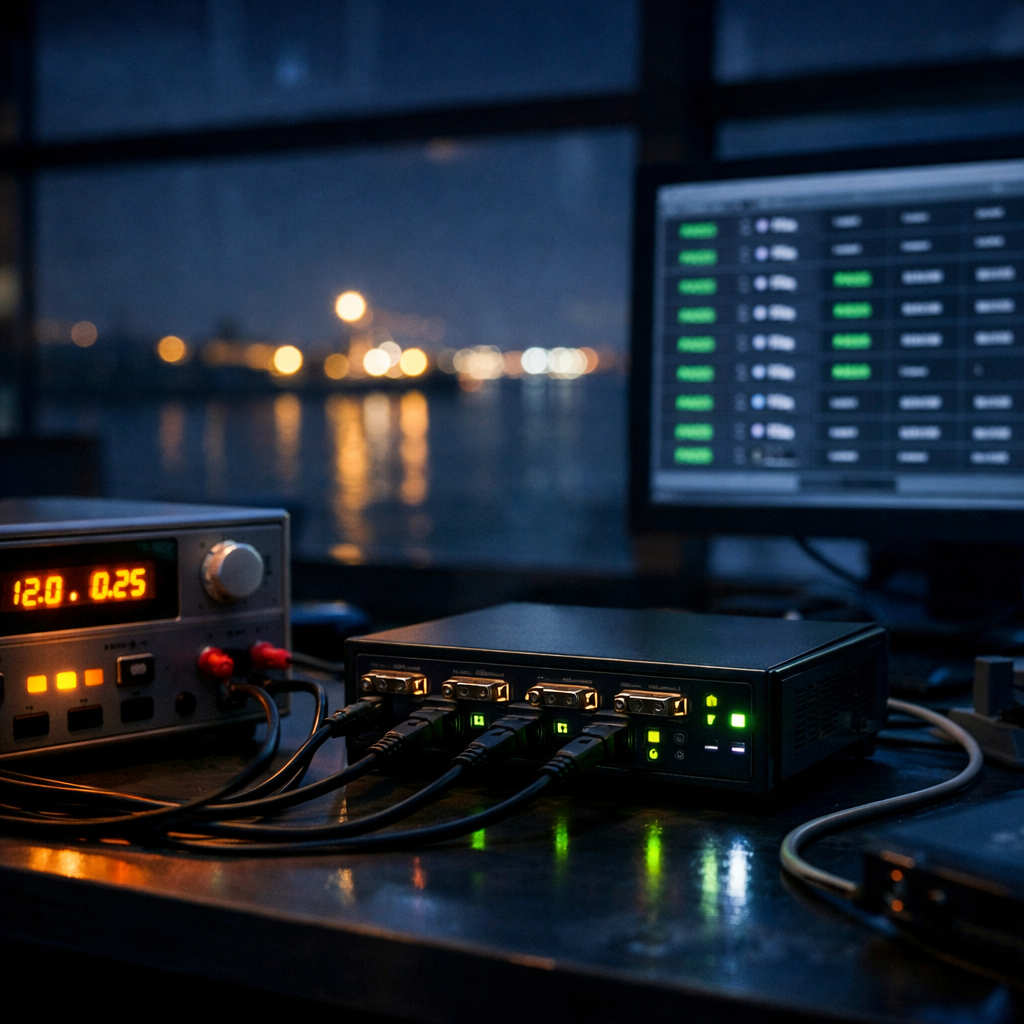
The Eleven-Week Problem
NordMux AS makes one thing exceptionally well. What they didn't have was a way to prove it — in a form that survives a notified body audit. How connecting a test bench to a living QMS gave a six-person startup something more valuable than a certificate.

NordMux AS makes one thing exceptionally well.
Their NM-4X is a four-port NMEA 0183/2000 multiplexer and protocol converter for ship bridge integration — the kind of device that sits quietly behind a navigation display, translating between instruments that were never designed to talk to each other. Configurable sentence filtering. Galvanic isolation on every port. A clean web UI that a retrofit integrator can configure in twenty minutes on a rolling ferry.
Six people. Ålesund. Eight years of accumulated knowledge about how maritime electronics actually behaves on working vessels in the North Sea. A genuinely good product.
And eleven weeks until type approval testing.
The call.
It came from their notified body on a Tuesday morning in February. The auditor was professional, methodical, and completely unmoved by the fact that NordMux had been shipping the NM-4X to satisfied customers for three years. Type approval under the EU Marine Equipment Directive — the Wheelmark — requires something that satisfied customers do not: a documented, traceable quality management system in which every formal requirement has a verified test result, and every test result is linked to a specific hardware and firmware revision.
NordMux had tests. Good ones. Spread across four engineers' laptops, two shared drives, a spreadsheet that had been the responsibility of whoever had time that week, and a folder called certification_FINAL_v3_USE_THIS_ONE that three people had independently updated without telling each other.
They also had 47 open firmware tickets. They shipped firmware updates approximately twice a week. Every update touched the sentence parsing engine in ways that were subtle, deliberate, and completely undocumented in terms of which IEC 61162-1 clauses the change might affect.
Kristoffer, the founder, put it simply: "We know our product works. We just can't prove it in a way that survives an audit."
What the standard actually demands.
IEC 61162-1 — the core standard for NMEA 0183 digital interfaces in maritime navigation equipment — is not a checklist. It is a set of requirements about behaviour: how a device receives sentences, how it transmits them, how it handles malformed input, how it performs across the full range of operating conditions specified in IEC 60945.
That last part is where most small manufacturers underestimate the work.
IEC 60945 defines the environmental envelope for maritime equipment: temperature, humidity, vibration, electromagnetic compatibility — and power supply variations. A Wheelmarked device must demonstrate correct operation across a supply voltage range that includes deliberate degradation. The standard doesn't care that your device works at nominal 24V. It wants to know what happens at 18V. What happens during a slow brownout. What happens when power returns.
And it wants that answer documented. Linked to a requirement. Linked to the firmware version under test. Repeatable.
For a team of six shipping firmware twice a week, "repeatable" is the word that changes everything.
The bench.
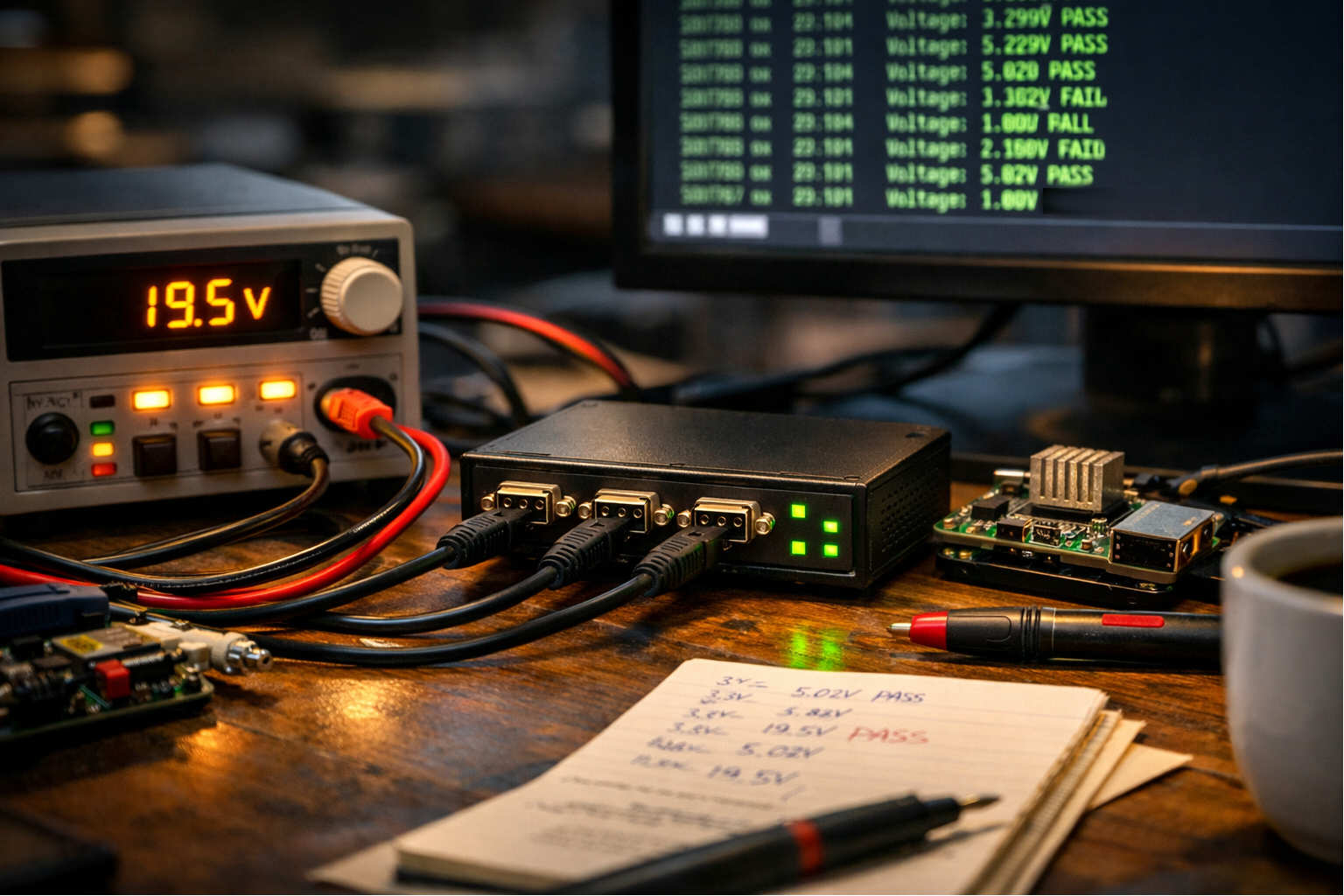
NordMux's test lab in Ålesund looks like every small hardware company's test lab: benches with more instruments than space, cables that have been there long enough to become furniture, a whiteboard with a diagram that may or may not still be accurate.
What they had, already, was the right equipment. A programmable DC power supply capable of stepping voltage under software control. A PC running NMEA sentence analysis. A collection of instruments that had always generated the right data — it just went nowhere permanent.
The question was not whether NordMux could run the tests. They could, and they had. The question was whether the results could be made to mean something — to a requirement, to a design specification, to the specific firmware binary flashed onto the device that morning.
We connected the lab.
What the brownout record looks like.
The NM-4X sits on the bench, running NMEA sentence load across all four ports. The programmable power supply steps the supply voltage down from 24V toward 18V in half-volt increments. At each step, the test holds for ninety seconds. The process running on the bench PC records supply voltage, current draw, sentence output rate, checksum error count, and inter-sentence latency for every measurement interval. Then the voltage steps back up. Recovery time is logged.
Every measurement lands directly in the quality record — not exported, not copy-pasted, not entered by hand. Linked to IEC 61162-1 and IEC 60945 §4.3. Linked to NordMux design specification DS-NM4X-003, which states operating range 18–32V DC. Linked to firmware v2.1.4, the build under test.
Marte, NordMux's test engineer, described what changed:
"Before, running that test meant two hours of work and a PDF that lived in a folder. Now the record exists the moment the test finishes. The requirement shows verified, the firmware version is there, and if we flash v2.1.5 tomorrow, we know exactly which tests need to run again."
That last sentence is the one that matters most for a team shipping firmware twice a week.
Eleven weeks later.
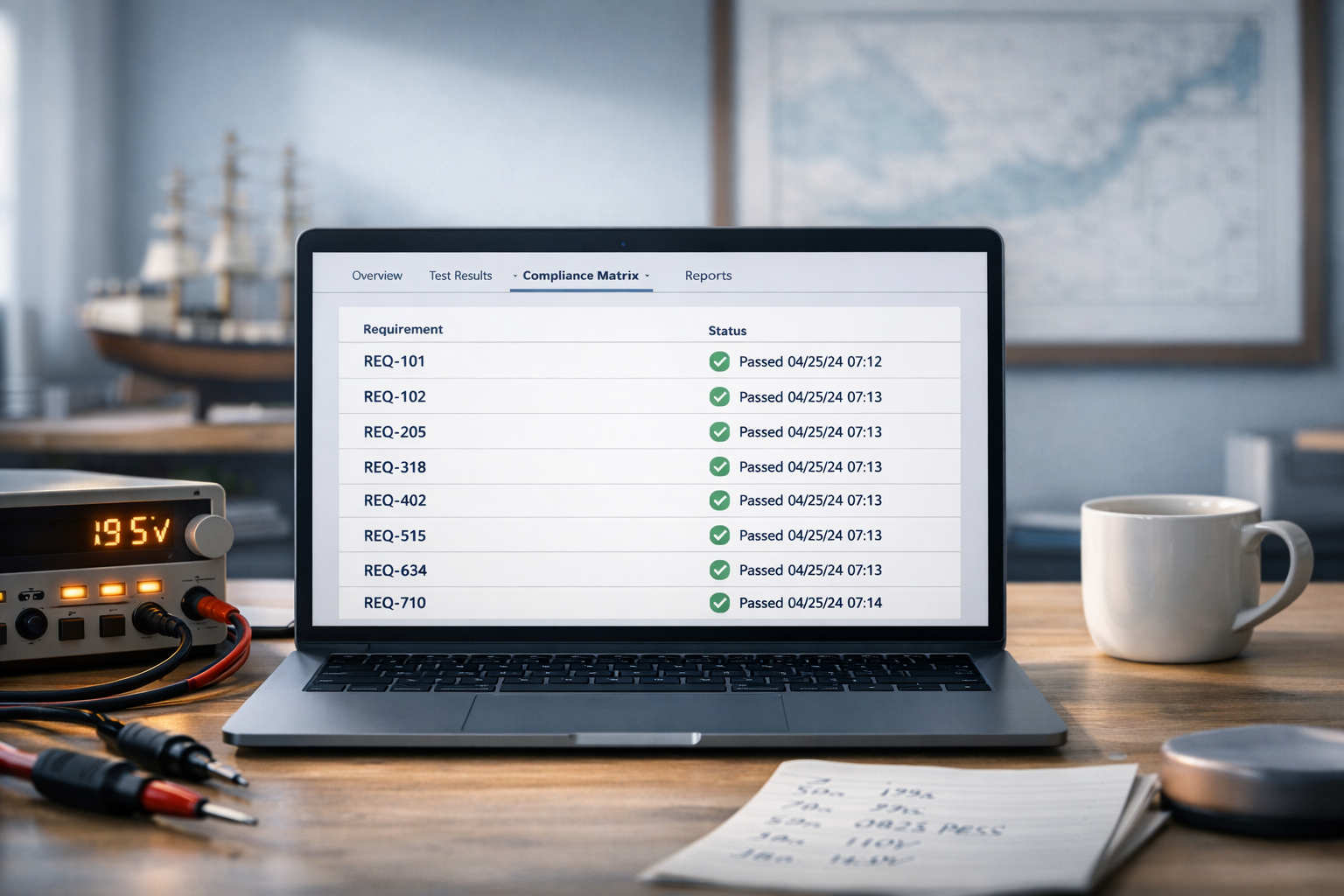
NordMux received their Wheelmark.
The audit went three hours. The auditor spent most of that time in the quality records — tracing requirements to test results, test results to firmware versions, firmware versions to the change log. At one point she asked about a specific IEC 61162-1 clause relating to sentence buffering behaviour under high input load. Marte pulled up the test execution record in thirty seconds. Measurements, timestamp, firmware version, pass criteria, result.
"She didn't say much," Kristoffer told us afterward. "But she stopped writing and just looked at it for a moment. I think that was the moment."
The certificate arrived six weeks after the audit. NordMux shipped their first Wheelmarked NM-4X units to a Norwegian shipyard in June.
What they have now.
The certificate matters for the market. But what NordMux built during those eleven weeks matters more for the company.
Every firmware release now carries a test status. Every requirement in their IEC 61162-1 compliance matrix has a timestamp showing when it was last verified and against which build. When a developer opens a ticket and changes the sentence parsing logic, the system shows which test definitions cover that behaviour — and flags them as pending re-verification against the new build.
They still ship firmware twice a week. Now they know exactly what each release has proven.
Four laptops. Two shared drives. A spreadsheet. No link between a firmware change and the tests it invalidated.
Every requirement linked to a test. Every test linked to a firmware version. Every measurement written automatically to the record.
The certificate opened the market. The traceability chain gave them control back. They still ship twice a week. The difference is now they know.
The programmable power supply on NordMux's bench was already there before we arrived. Their NMEA analyser was already generating data. Every instrument on that bench was already capable of producing exactly the measurements the standard required.
The gap was not capability. The gap was connection — between the instrument generating the number and the record that gives the number meaning.
If your hardware already lives in your customers' test labs, it is already close to the compliance record. Closer than you might think. The instrument speaks directly to the record. That is the direction this is going — and the companies that build for it now will be the ones their customers rely on when the next audit call comes.
Does this match a challenge you're facing?
We read every response personally — your question shapes what we build next.